
An article published in Fulcrum Issue 96 Summer 2025, Craniosacral Therapy Association
This article was written to draw the attention of Registered Craniosacral Therapists to the day-long Authentic Movement course in October 2025, hosted by the Craniosacral Therapy Association UK. I share my journey of the embodied movement practice, which complements and deepens my personal development and craniosacral work.
Cultivating Embodied Awareness
How authentic movement practice deepens craniosacral work
Katsura Isobe
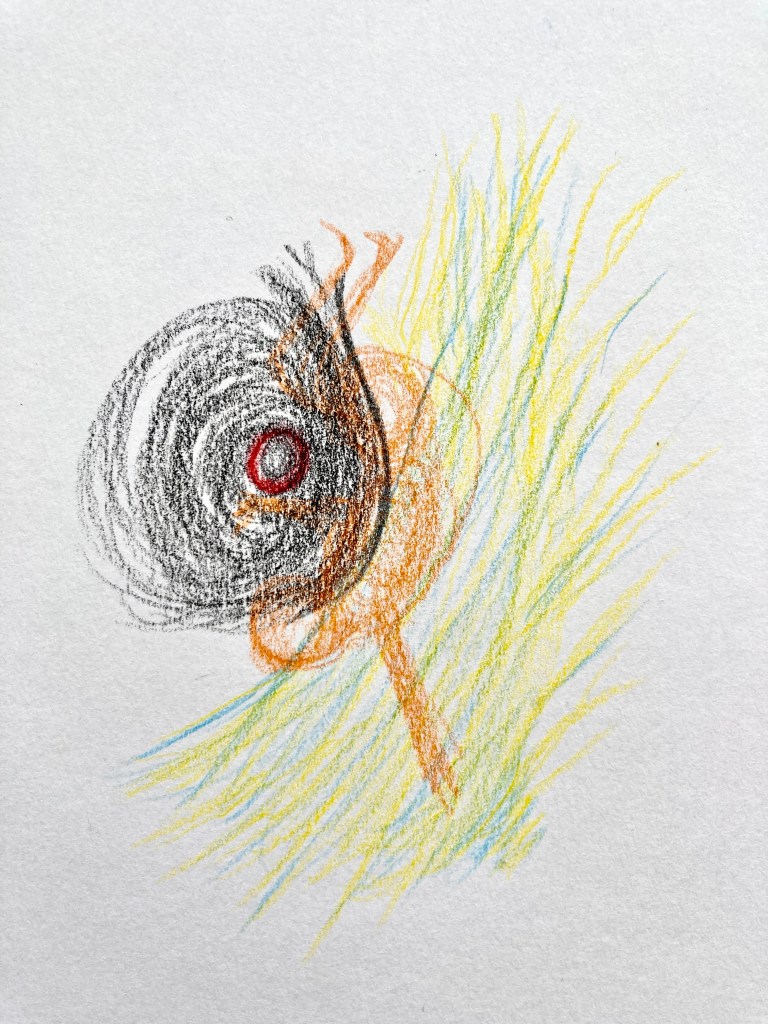
My heart wakes up and starts to withdraw all of a sudden.
On the floor,
pulled into my heart
are up and down along the midline my face and pelvis.
My left half body contracts and pulls me into a small ball.
Tears well up.
I miss, I grieve, and I long for.
I am about to accept the tenderness of nursing my old wounds.
Then a flash of thought comes; This is all familiar.
What else?
My right half body draws my attention – light and spacious.
My body starts unfolding and opening up I may take this spaciousness into my body.
I roll onto my back
with my arms extended to the sky. I am receiving light into my palms.
(Reflective drawing and poem from my Authentic Movement practice)
———
My two practices, craniosacral therapy and authentic movement, developed together, referencing each other more and more as the journey deepened. I graduated from the College of Cranio-Sacral Therapy in 2016, and a year later, I stepped into the practice of the Discipline of Authentic Movement with Linda Hartley. Both practices slow me down to attend to each moment. In both practices, away from the mundane social context, I feel allowed to sense and feel everything unfolding in the moment within myself, another, and our relational field. I drop into a liminal space where I encounter the mystery, the unknown, and sometimes a magic of healing occurs. Healing – It is called embodiment when we work through our bodies.
A Journey Towards Embodied Awareness
Authentic movement is an embodied awareness practice, as is craniosacral therapy. The discipline of authentic movement has a distinct format, or rituals, that encourage practitioners to delve into the depths of their consciousness while maintaining the awareness of their bodies. The body is the vehicle of this journey. With awareness of the physical body and its sensations, more dimensions of bodily experiences unfold: feeling, emotion, image, and even thought. Thoughts that come through the body are different from those of logical thinking. They are direct and intuitive-knowing.
Through my experience of practising and teaching authentic movement over the years, I started noticing how the embodied awareness grows in practitioners. It is not a linear development, and there is no completion. We constantly go back and forth in these phases to encounter more details and gain more clarity. However, especially at the beginner’s stage, there are phases in development, starting with awareness of the self; moving, sensing, feeling and imagining. From there, awareness towards others and their relationships with them continues to develop. Authentic movement practice also involves speaking of their experience, which creates a bridge between non-verbal experience and verbal expression.
Constantly checking if each action is aligned with bodily feelings, embodied awareness grows. It is a transformational practice whose effects ripple out into professional and personal life. As mentioned earlier, my craniosacral and authentic movement practices have been developing hand in hand.
I have noticed that, for Authentic Movement, my Craniosacral practice offers a great awareness of our bodies and our relational field. For Craniosacral Therapy, Authentic Movement showed me how to stay with myself and relate to another. As an empath, I used to get drawn and lost in my client’s inner world. I was not even aware that I was merging with them. Today, my awareness of my own body, sensations and feelings brings a clearer seeing of what is expressed in the client’s body. Moreover, I have found verbalising this perception of mine in a non-diagnostic and non-judgmental way often opens up something in the client’s processing. My experience in authentic movement practice has enhanced my craniosacral practice, making it more creative and engaging in my unique way. I believe authentic movement has a lot to offer you as you move forward with one’s CST practice.
Authentic Movement In Practice
The following describes my experience of authentic movement practice in stages. I hope some moments resonate with your experience in CST practice, as with mine.
To begin with, as the fundamental structure, authentic movement is practised in the container of the relationship between a mover and a witness. A mover moves with closed eyes, following their spontaneous inner impulse. A witness holds the space and attends to their experience of witnessing the mover. Now, this relationship would be a client and a therapist in a CST session. A witness/therapist is present for the mover/client.
1. Moving and being moved with the inner world
I am a mover, standing in the circle. I close my eyes and enter my body. I notice many sensations of busyness in my body. I soften my body and receive all of this. Scattered buzzing around the head, tightness in my chest, in-breaths and out-breaths, floaty feeling in the belly, slight shift of my weight through the sole of my feet, etc. I stay and witness my sensations until they start to settle, and one comes to the foreground in my attention. Once my attention is caught, I follow. I let my body move with it. My body finds its way, which brings more sensations to my attention. I may choose to stay with the initial sensation I was drawn to, or that
may already be gone, and my attention may shift to another one. Moment by moment, my attention and movement weave with each other. And there is a moment that comes when I have no clear thread. I pause. I am facing the unknown. And within the unknown, my senses heighten; what I hear, touch, smell outside my body and feel inside my body. Although I feel somewhat uncomfortable not knowing what comes next, I trust there is always something that emerges. A more profound feeling or emotion may surface, or an image or memory may sweep the whole of me. I do not know yet what will unfold, and until that happens, I am with the unknown. I may end up simply changing my positions as my body physically becomes tired after a prolonged pause. So be it. It is, anyway, the beginning of the new thread.
As I continue to pick up, follow and lose a thread in all unexpected ways, I descend into the depths of consciousness. While I am utterly awake and fully present, I feel I am dreaming. In the flux of sensations and feelings, I am having an extremely intimate dialogue with myself. I often encounter complicated feelings and less conscious material, as well as life-affirming moments, in this liminal space. My processing will continue to the later parts of this practice.
2. Cultivating the inner witness by tracking our experiences
Of course, there are times when I struggle to engage in the practice. I may be going around in my head what I saw and heard before the practice. I may be worried or feeling uninspired. Indeed, it is not easy to drop into the space. In these cases, rather than beating myself up to engage, I have learned simply to be myself. I witness myself being bothered and having difficulty dropping into the practice.
It may sound like a paradox that I am in my body, sensing and feeling, and simultaneously, I see myself from outside. This part of me, seeing the moving self from outside, is called the inner witness. My inner witness tracks my experience in each aspect of movement, feeling, emotion, imagination and thought. It is not that every element is present all the time, but having such a map of experience helps me to notice less conscious parts. Here is an example.
An image of a rock comes to me. [imagination]
I am kneeling. My whole body is held and stiff. [movement] As I feel into this, I notice I hold anger in my body. [emotion]
In this case, my emotion is a less conscious part, which may not have been noticed if I had not learned to pay attention to various aspects of experience beyond the first impression. The practice cultivates awareness. Awareness turns the unconscious into the conscious. Consciousness transforms our beings.
3. Transitioning from liminal to ordinary space
As a mover, I hear the bell three times, which marks the end of the moving circle. I slowly open my eyes and walk back to the circle where I started. Time feels stretched out. I take my time to find my notebook and pencils and sit comfortably against the wall of the room. I feel full and empty at the same time. I want to draw or write something on the blank page in front of me to reflect on my moving experience. Some moments appear and disappear in my mind. That continues for a while until I notice a hook that I feel attached to a particular moment. I start by choosing the colour of a pencil and then draw a line or write a word. I re-enter the moment I
experienced and bring something back to the page, another line, or another word. As I continue, I start remembering the moment more vividly, and something becomes clearer – what may matter to me the most in that particular experience.
During this time after the moving circle, a transition occurs from my deep inner world to the physical space in the studio. In the drawing and/or writing, it feels so potent to see the alchemy of my intangible experience gaining some form. This is an act of creating a bridge between liminal and ordinary spaces.
4. Clear speaking
I come back to the circle, sitting. In the speaking and listening circle, each mover takes turns speaking from their experiences and then listening to what the witnesses offer. ‘Speaking from the experience’ is an embodied speaking that takes the mover right back to the moment that they are sharing. It differs from ‘speaking about the experience’, which has an objective perspective. We focus on our subjective experiences with each practitioner’s body.
It is my turn to speak. Having become clearer about my moving experiences during the transition period, I am more ready to share them with others. I re-enter my body, remembering moment by moment to describe my movements, sensations, feelings, images and/or thoughts. I take my time to choose the words that are true to my experience. And I want to communicate. I hope the listeners are with me, bodily imagining the moment I am speaking of.
I finish speaking. A witness speaks of their experience of that moment, which I may resonate with, not resonate with, or may help me recall and clarify more details of my experience. Often, my perception of the experiences is reshaped by hearing the words of the witnesses. With the witness’s non-judgmental and compassionate attitudes, I feel my experiences are affirmed, and my attitude towards them also softens. Here is another alchemy, where my perception of my experience shifts.
5. Embodying the therapeutic presence
Authentic movement is a relational practice that encompasses relationships within the self and between the self and others. What we cultivate in this practice is a non-judgmental and compassionate presence towards ourselves and others, which Linda Hartley refers to as therapeutic presence. As Craniosacral Therapists, we value this presence highly. Cultivating the therapeutic presence is an embodiment practice that transforms the personal and professional self, and consequently, clients and others around us.
Returning to my body, paying full attention to my experience moment by moment in both my professional and personal life, I find this most pleasurable for my soul. And my soul is nourished with other persons in compassionate and non-judgmental communities. It is a conscious choice for us, as Craniosacral Therapists, to attend to the bodies and belong to this community, despite many other societal values. Likewise, cultivating embodied awareness is a path we choose to walk. Shall we walk together? I invite you to the authentic movement practice.
Katsura Isobe is a somatic therapist-teacher-artist. She is a registered craniosacral therapist and registered master somatic movement therapist with over 30 years of professional experience in dance. In collaboration with CSTA, Katsura will be holding a day-long authentic movement course in London on 12th October. http://www.katsuraisobe.net
Further reading
Adler, J. Morrissey, B., & Sager, P. (eds) (2022) Intimacy in Emptiness. An Evolution of Embodied Consciousness. Rochester, Vermont: Inner Traditions.
Hartley, L. (2024) Embodied Spirit, Conscious Earth. From Embryology to Embodied Relational Spiritual Practice. Axminster, England: Triarchy Press.
 katsuraisobe.net